Community Artists Talk Numbers
Artists share some thoughts on making the most of numbers when designing an impactful paint scheme.


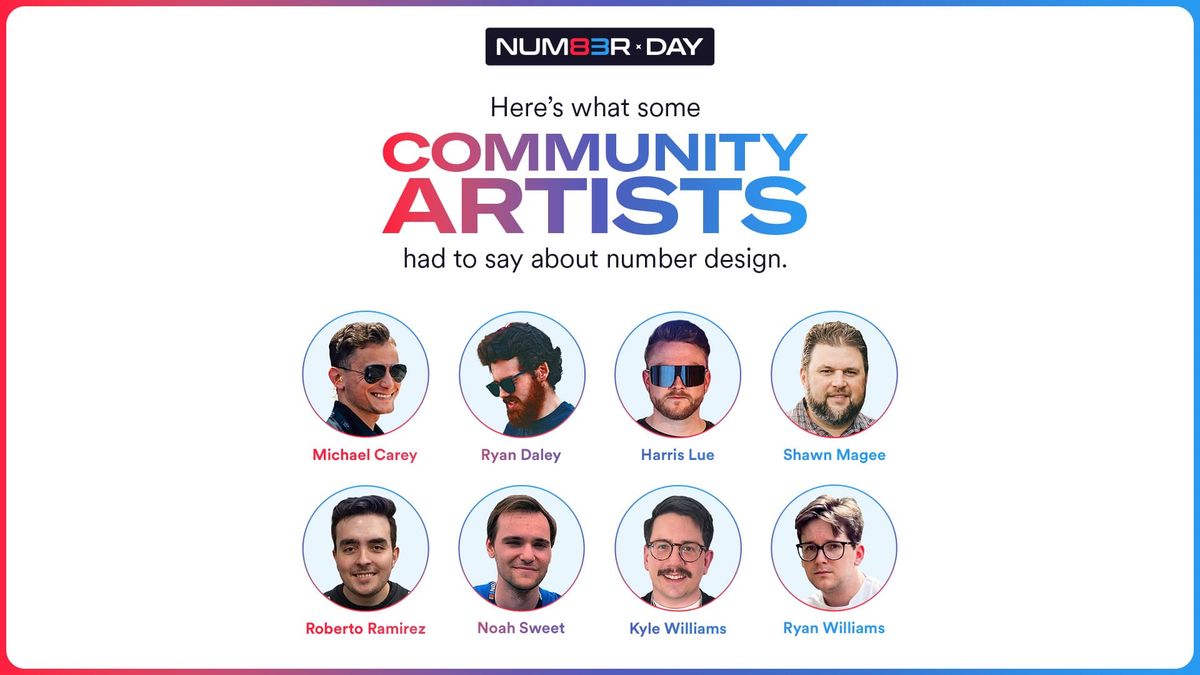
In celebration of Number Day, we asked some artists we’ve talked to in the past some of their thoughts about numbers when it comes to their role in livery design.
Many thanks to Michael Carey, Ryan Daley, Harris Lue, Shawn Magee, Roberto Ramirez, Noah Sweet, Kyle Williams, and Ryan Williams for participating.
What makes a good number design?
Ryan Daley: “Something that is easy to make out on TV, plenty of spacing if it’s multiple digits. Don’t get too crazy with shadows and strokes. If you can do fluorescent go for it.”
Roberto Ramirez: “Personally, I think that motorsports numbers are a crazy thing because there are several factors at play that can make a number design great. When TRICON was in the baby steps of their brand with the switch to Toyota in 2023, I got to see my friend Matthew LaSasso’s mind at work as he developed a font to pitch for them which would eventually become the font that what we know and love. We wanted something that was bold, readable, and looked fast while also not closely resembling any other team on the track; bonus points for readable. When I still do the odd paint scheme design for TRICON, a go-to style over the years for them is making the number outline the same color as the base so it looks like there’s no stroke. I think it looks really clean and has helped their trucks look a little more modern than most teams. On the other hand, my full-time job at LEGACY MOTOR CLUB is an example of another way that a number font can become great: winning a ton of races. The legacy of the number 43, with the history of the Petty family and the 200 wins to its name, makes it special any time I get to design a car with that on the door. The Wood Brothers 21, RCR 3, and Hendrick 24/48 are also some good examples of this. The numbers that defined our sport still being on track means a lot to every generation of fan, I think, and the ones that I listed prior are pretty much untouchables.”
Noah Sweet: “Anything more than two outlines is entirely unnecessary and creates far too much visual complexity, in my honest opinion. A good number design doesn’t need an outline at all in an ideal scenario; if it interacts beneficially with the paint scheme design it can subtly present itself just as prominently as the sponsor logos. TRICON Garage understands the importance of said practice where a number should have at most, one bold outline/holding shape/offset drop shadow behind it to separate it from whatever design element passes behind the number. Sometimes the holding shape can have an accent colored outline much like how RFK Racing handles their team-branded font. JR Motorsports and Alpha Prime Racing practice both of the previously mentioned methods depending on what kind of design sits behind their numbers for maximum cohesion between scheme and team branded number fonts.”
Ryan Williams: “Leans forward, isn’t too big, and designed like a logo not a font. Also, not 50 million outlines.”
Share a tip with the Trading Paints community! What’s one way to make a number pop on your design?
Michael Carey: “Perform the cross-eye test: look at your scheme and cross your eyes. If you can easily identify the silhouette of the number, you’re good. If you cannot, you may need to change color, add a stroke or drop shadow, etc. Too many drop shadows or strokes can take away from the scheme, so trial and error!”
Ryan Daley: “Always try and use a contrasting color for the number compared to the color(s) behind; you never want it to blend with the background. One of the worst offenders I regularly see is white numbers on a mostly white background. You want the number at stand out.”
Harris Lue: “The best is when you can plan your design elements around the number you're working with. Making sure that the number is incorporated into the design and not just overlayed onto it will make the number seem like a natural part of the artwork and increase visibility and legibility on track!”
What’s the coolest-looking two-digit number combination?
Shawn Magee: “The 18 from JGR [Joe Gibbs Racing] has always looked solid. Seems to just fit well together with no awkward gaps between the numbers.”
Kyle Williams: “I’m a big fan of how a 99 looks on any race car.”
Ryan Williams: “I like the Yates 28 from 1991-1993 a lot.”
If you had to live with just one number on every project you worked on again, what would that number be and why?
Michael Carey: “The Hendrick Motorsports 25 from 2007. The first die-cast I ever bought from the track as a kid, and the No. 25 was a favorite of mine as a kid with Jim Thome as a Philadelphia Phillie. It’s a number and style that I advocated for via social over the years for Hendrick Motorsports to return to and other users will tag me if they see the number in the wild. It’s fun to connect yourself to a number and that style, and number will forever be my favorite.”
Ryan Daley: “It would have to be 00. Working with that number at StarCom was great. It’s symmetrical and with no weird gaps, it goes on top of any design cleanly.”
Harris Lue: “Number 50. Not only do I have a Ford 5.0 in both of my cars, but it’s always been my personal favorite sports number dating back to the jersey I wore playing high school football.”
Shawn Magee: “A single-digit number because it allows for more flexibly space-wise.”
Roberto Ramirez: “42. It was my go-to sim racing number for years and also happens to be one of the numbers that we use at LEGACY, so it checks a lot of boxes!”
Noah Sweet: “A big, wide, squared off single digit number. The pre-2025 JRM 8, for example. Those kinds of numbers don’t allow any small hits of the scheme design to peek through the varied weights of a slim two-digit number font. Those slim numbers are typically the hardest to deal with and benefit most from outlined holding shapes.”
Kyle Williams: “The number 70 would be the one number I’d love to live with on every project I ever worked on. Specifically, using Tricon Garage’s unique number set would be ideal. The number is what my dad raced while I was growing up. I drew that number on every car for as far back as I can remember. It’s also not a widely used number, and isn’t tied to any one driver in the modern era.”
Ryan Williams: “The current JRM [JR Motorsports] 8.”
For more Number Day celebration, follow Trading Paints on Instagram.